
Have you ever ordered T-shirts that fit perfectly when they arrived, only to discover that they became smaller after washing? For an individual, this can be frustrating. But when a company, school, college, or event organiser orders hundreds of T-shirts, fabric shrinkage can become a much bigger problem.
Imagine ordering 500 custom T-shirts for your employees or an upcoming event. If the T-shirts shrink after washing, the fit may change, uniforms may become uncomfortable, and replacement costs may add up. This is why understanding fabric shrinkage is essential before placing a bulk T-shirt order.
In this guide, we will explain why T-shirts shrink, how to reduce the risk, and what bulk buyers should check before choosing a T-shirt manufacturer.
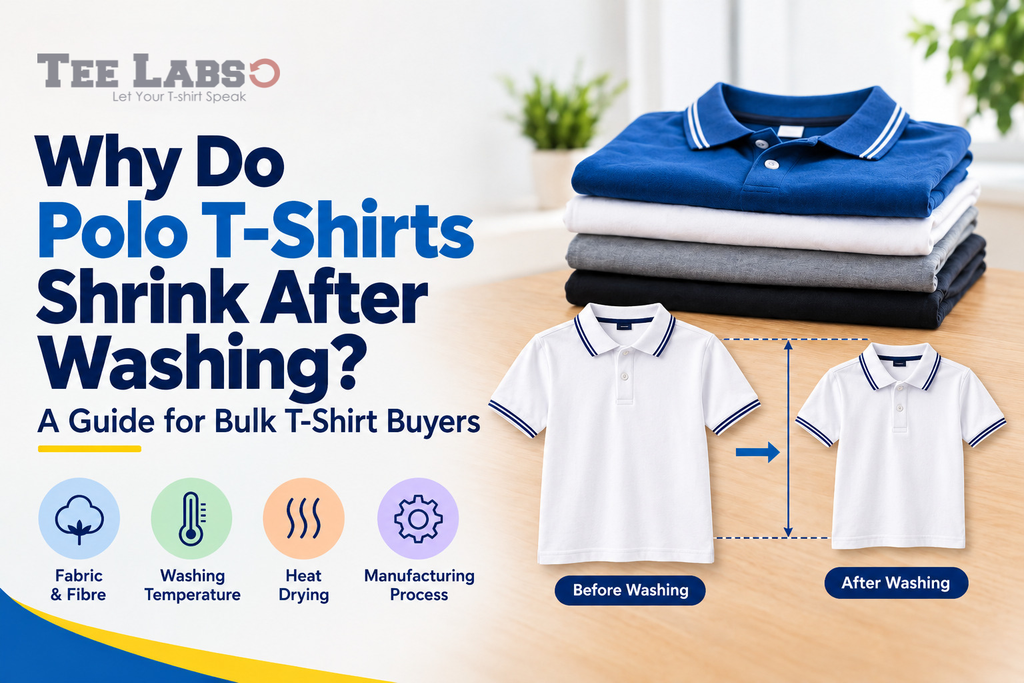
What Causes T-Shirts to Shrink After Washing?
T-shirt shrinkage occurs when the fabric or garment becomes smaller after washing or drying. Several factors can contribute to this change.
1. Fabric Structure and Fibre Properties
Cotton is widely used for T-shirts because of its softness and breathability. However, cotton fibres and knitted cotton fabrics can relax or contract when exposed to moisture and movement during washing.
The amount of shrinkage depends on several factors, including the fabric construction, yarn properties, manufacturing process, and previous treatments.
Different fabrics behave differently, so it is important to evaluate the specific fabric rather than assume every T-shirt will shrink by the same amount.
2. Washing Temperature
Hot water can increase the risk of shrinkage in certain fabrics, particularly when the fabric has not been adequately stabilised during manufacturing.
Following the garment’s care label and using the recommended washing temperature can help maintain its original size and fit.
3. Excessive Heat During Drying
High heat during tumble drying can contribute to shrinkage in susceptible fabrics. Repeated exposure to excessive heat may also affect the garment’s appearance and overall condition.
Whenever possible, follow the recommended drying instructions for the fabric and garment.
4. Inadequate Shrinkage Control During Manufacturing
Fabric preparation and finishing play an important role in garment quality.
Processes such as pre-shrinking and compacting can help control dimensional changes in suitable fabrics. However, the results depend on the fabric type, processing conditions, and quality-control procedures.
That is why fabric selection alone is not enough. The manufacturing and finishing processes also matter.
Why Is T-Shirt Shrinkage a Bigger Problem for Bulk Orders?
When purchasing T-shirts in bulk, consistency is just as important as appearance and price.
Consider a business ordering custom T-shirts for its employees. If the garments shrink significantly after washing, employees may experience fitting issues. The company may then need to arrange replacements or place another order.
For schools, colleges, sports teams, and event organisers, shrinkage can create similar difficulties.
Here are three reasons why bulk buyers should pay attention to shrinkage control:
Additional costs: Replacing garments or ordering additional stock can increase the total cost of the order.
Inconsistent fitting: T-shirts that change size after washing may no longer provide the intended fit and comfort.
Reduced customer satisfaction: Poor garment performance can affect the experience of employees, students, team members, or event participants.
The important point is that the initial purchase price does not always represent the total cost of ownership. Fabric performance and garment durability should also be considered.
How Can You Reduce the Risk of T-Shirt Shrinkage?
Although shrinkage cannot always be eliminated completely, the right selection, manufacturing, and care practices can help reduce the risk.
Choose the Right Fabric for Your Purpose
Before placing an order, consider how the T-shirts will be used.
Corporate uniforms, promotional T-shirts, everyday wear, and premium oversized T-shirts may require different fabric weights and constructions.
Ask your manufacturer about the fabric composition, construction, finishing, and suitability for the intended use.
Ask About Shrinkage-Control Processes
If you are ordering a large quantity, ask whether the fabric has undergone appropriate shrinkage-control processing, such as pre-shrinking or compacting where suitable.
Do not assume that every cotton fabric has received the same treatment. Confirm the actual process used for your selected fabric.
Request Wash-Test Information
A wash test can help assess how a fabric or finished garment responds to washing.
For bulk orders, ask whether dimensional stability has been tested and whether the results are available. Where appropriate, request measurements before and after washing.
This helps you make a more informed decision before committing to a large quantity.
Follow the Recommended Care Instructions
Even properly processed fabrics require appropriate care.
Follow the washing temperature, drying instructions, and other care recommendations provided for the garment. Avoid excessive heat when the care instructions advise against it.
What Should You Check Before Placing a Bulk T-Shirt Order?
Before finalising your next order, use this simple checklist:
- Confirm the fabric composition and construction.
- Ask about shrinkage-control processing.
- Check whether wash testing has been performed.
- Review the fabric’s dimensional stability results, if available.
- Confirm the expected fit, size specifications, and garment measurements.
- Follow the recommended care instructions after delivery.
Taking these steps can help you compare manufacturers more effectively and reduce the risk of unexpected problems after delivery.
Why Fabric Selection Matters at TeeLabs
At TeeLabs Apparels Pvt Ltd, we understand that custom T-shirt manufacturing involves more than choosing a colour and adding a logo.
The fabric, garment design, construction, stitching, and finishing all contribute to the final product.
Whether you need corporate uniforms, promotional T-shirts, team apparel, or custom-designed garments, it is important to select materials that suit the intended use and production requirements.
For bulk buyers, discussing fabric specifications and shrinkage-control requirements before production can help establish clearer quality expectations.
Our approach to custom T-shirt manufacturing focuses on planning the garment around your requirements, from fabric selection and colour choices to cut-and-sew construction and customisation.
T-shirt shrinkage may seem like a small issue when purchasing a single garment. But when you order hundreds of T-shirts for employees, students, customers, or an event, it can lead to fitting problems, additional expenses, and unnecessary inconvenience.
The best way to reduce this risk is to make informed decisions before production begins.
Choose the right fabric, ask about shrinkage-control processes, check wash-test information, and follow the recommended care instructions.
Planning a bulk custom T-shirt order? Talk to TeeLabs about your fabric requirements, garment design, and manufacturing specifications before production begins.