
Have you ever bought a T-shirt because it had a higher GSM, believing it would automatically be better quality?
You are not alone. In the T-shirt market, GSM is often used as a selling point. A 220 GSM T-shirt may be marketed as premium compared to a 180 GSM T-shirt, with a higher price to match. But does a higher GSM always mean better quality?
The truth is that GSM measures fabric weight, not the complete quality of a T-shirt.
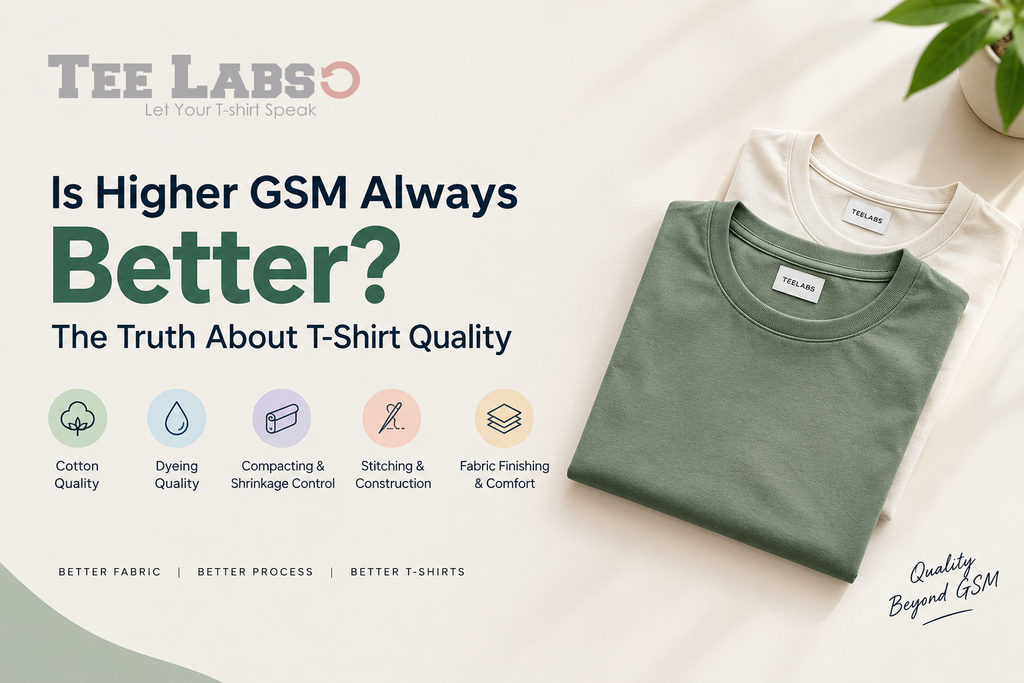
What Is GSM in T-Shirts?
GSM stands for Grams per Square Meter. It measures the weight of one square meter of fabric. A higher GSM generally indicates heavier fabric, while a lower GSM indicates lighter fabric.
However, fabric weight alone cannot tell you everything about its quality, comfort, durability, or performance after washing.
5 Factors That Determine T-Shirt Quality Beyond GSM
1. Cotton Quality
The quality of cotton used in a T-shirt plays a major role in its softness, strength, and durability. Two fabrics can have the same GSM but feel completely different because of their cotton quality, yarn characteristics, and construction.
Even a heavyweight T-shirt can feel rough or wear out quickly if it is made using lower-quality materials.
2. Dyeing Quality
A T-shirt’s colour should look good not only when it is new but also after repeated washing.
Proper dyeing processes help achieve consistent colours and good colourfastness. Poor dyeing can lead to fading, uneven shades, or colour bleeding. Therefore, a high GSM fabric with poor dyeing quality may not deliver the expected value.
3. Compacting and Shrinkage Control
Have you ever worn a T-shirt that fitted perfectly before washing but became smaller afterwards?
Fabric compacting is one of the processes used to control shrinkage in knitted fabrics. If shrinkage is not properly managed, the garment’s fit and dimensions can change after washing.
A higher GSM does not automatically prevent shrinkage. Proper fabric processing and testing are essential.
4. Stitching and Construction
A T-shirt is more than just fabric. Its overall quality also depends on how it is manufactured.
Strong seams, properly attached collars, well-finished sleeves, consistent stitching, and good finishing contribute to the garment’s durability and appearance.
Even premium heavyweight fabric cannot compensate for weak stitching or poor garment construction.
5. Fabric Finishing and Comfort
The knitting structure, yarn quality, finishing treatments, and fabric surface all influence how a T-shirt feels against the skin.
Two T-shirts with identical GSM can differ significantly in softness, breathability, drape, and comfort. The best fabric is the one that suits the intended use, not necessarily the heaviest one.
How GSM Is Used in T-Shirt Marketing
Imagine two T-shirts.
T-shirt A is made from good-quality cotton, with proper dyeing, shrinkage control, and strong stitching. It weighs 180 GSM.
T-shirt B weighs 220 GSM but uses lower-quality cotton and has inconsistent dyeing, inadequate shrinkage control, and poor stitching.
Which one offers better value?
T-shirt A could perform better in terms of comfort, colour retention, fit, and durability, despite having a lower GSM.
This is why customers should be careful when comparing T-shirts based on GSM alone. A higher GSM may justify a higher price when the fabric and construction meet the required standards, but weight alone does not prove superior quality.
What Should You Check Before Buying Custom T-Shirts?
Whether you are ordering corporate uniforms, promotional T-shirts, event merchandise, or apparel for your own clothing brand, ask your manufacturer about:
- Cotton and yarn quality: What materials are being used?
- Dyeing and colourfastness: Will the colour remain consistent after washing?
- Compacting and shrinkage: Has the fabric been processed and tested for dimensional stability?
- Stitching and finishing: Are the seams, collars, and garment construction reliable?
- Fabric performance: Has the fabric been evaluated for comfort, durability, and its intended use?
For bulk orders, requesting a fabric swatch or sample garment and conducting wash tests can help you make a more informed decision before approving production.
GSM is an important factor when selecting T-shirt fabric, but it should never be the only measure of quality. Cotton quality, dyeing, compacting, stitching, fabric construction, and finishing all contribute to the final product.
The next time someone tells you that a T-shirt is better simply because it has a higher GSM, ask about the manufacturing quality behind that number.
A premium T-shirt is not made by weight alone. It is made through the right materials, the right processes, and the right manufacturing standards.
At TEELABS APPARELS PVT LTD MADURAI, custom T-shirts are manufactured from scratch, with attention to fabric selection, colour, design, garment construction, and finishing.
From corporate uniforms and promotional T-shirts to polo shirts, oversized T-shirts, hoodies, and sweatshirts, the goal is to create apparel that suits your requirements—not just a number on a fabric specification sheet.
Visit www.teelabs.in to explore custom T-shirt manufacturing.